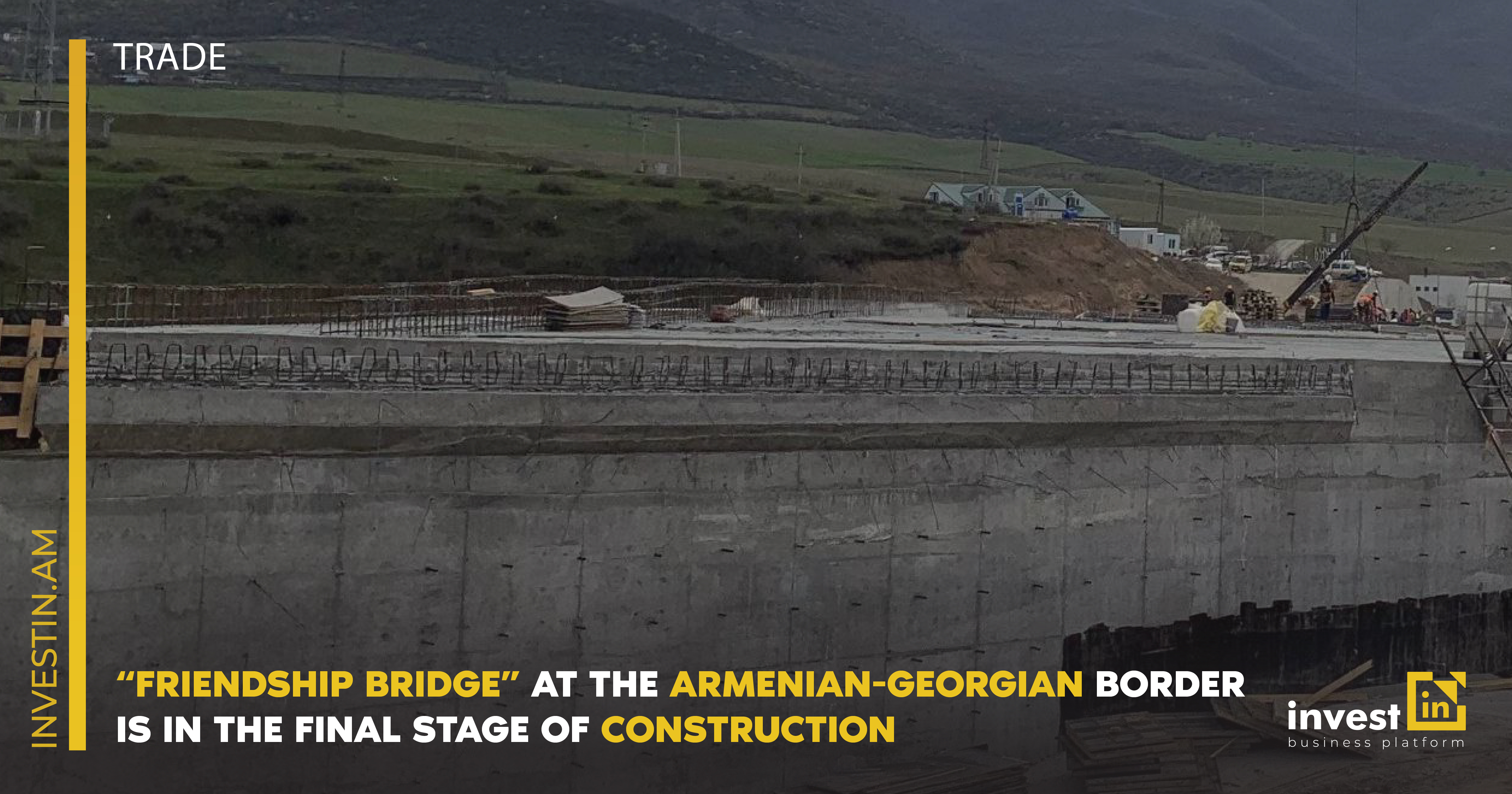
The construction of a new bridge named “Friendship Bridge” on the Armenian-Georgian border is at the final stage. The bridge at the Sadakhlo-Bagratashen checkpoint is the main crossing between Georgia and Armenia. An upgrade of the existing infrastructure that allows the transit of people and goods across the border is essential to support regional trade and cooperation between the two countries.
The project is a joint Armenian-Georgian program supported by the European Bank of Reconstruction and Development (EBRD) and the Armenian and Georgian governments. The EBRD is the leading institutional investor in Armenia. The Bank has invested about $2,000,000,000 in more than 200 projects in the country’s financial, infrastructure, industrial, mining, corporate, and energy sectors, with an 82% share of its investment portfolio being in the private sector. EBRD’s current portfolio of projects costs about $450mln.
As mentioned, EBRD participates also in the “Friendship Bridge” project aiming to improve the cross-border bridge connecting Armenia and Georgia. The project cost is about $11,000,000, committed as part of the Northern Corridor Modernisation Project, a regional initiative to modernize and upgrade the border infrastructure to EU standards. In addition to the EBRD, the European Investment Bank, the European Union, and the United Nations Development Programme, jointly with the governments of Armenia and Georgia, committed to financing this project, with a total cost of more than $65,000,000. The project envisages two bridges located at a distance of 1 meter from each other, each bridge will have two lanes. The capacity of the new bridge is 4 times higher. Thanks to this, vehicles will not have to park on the bridge, the customs checkpoint process will take place faster, and will be more convenient and modern. Large-scale works have already been carried out and it remains to install barriers, build sidewalks, pave the road and carry out markings.
Moreover, in Armenia’s southern customs posts, reforms are underway that will reduce the waiting time from 2-3 days to 2-3 hours. Today at the customs post there are 5 services: the NSB, food security, police, customs, and transport services. Following the reforms, a one-stop-shop will be available at the customs points with only 2 available bodies The National Security Council and the Customs Service, which will share the functions of other bodies. The program aims to significantly reduce waiting times by submitting all documents through one window.
Besides, Russia is taking steps to increase the capacity of the Upper-Lars border crossing with Georgia. The country will add 12 additional lanes at the border point by August 2022, with 12 more by the end of the year, bringing the total number of lanes to 39 (currently 14). Hundreds of people are involved in the reconstruction of the checkpoint. Previously, the checkpoint passed up to 1,500 cars per day. To date, the measures taken have increased the throughput to 2,300 vehicles per day, including 1,100 trucks. As Armenia’s major trade partner is Russia, that will surely have a positive effect on the country’s foreign trade. According to the results of January-April of the current year, the trade turnover between Armenia and Russia increased by 30% and exceeded $890 million. Moreover, the volume of Russian investments amounted to more than $2 billion.
Armenia’s foreign trade turnover in January-February 2022 amounted to $1 420 700 000, which is 52.4% more than in the same period of 2021. In February 2022, however, the rate increased by 44.9% compared to the same period in 2021, and by 11.9% compared to January 2022. In January-February 2022, foreign trade turnover in drams amounted to 683.5 billion drams. New border reforms will help to increase Armenian foreign trade much more.